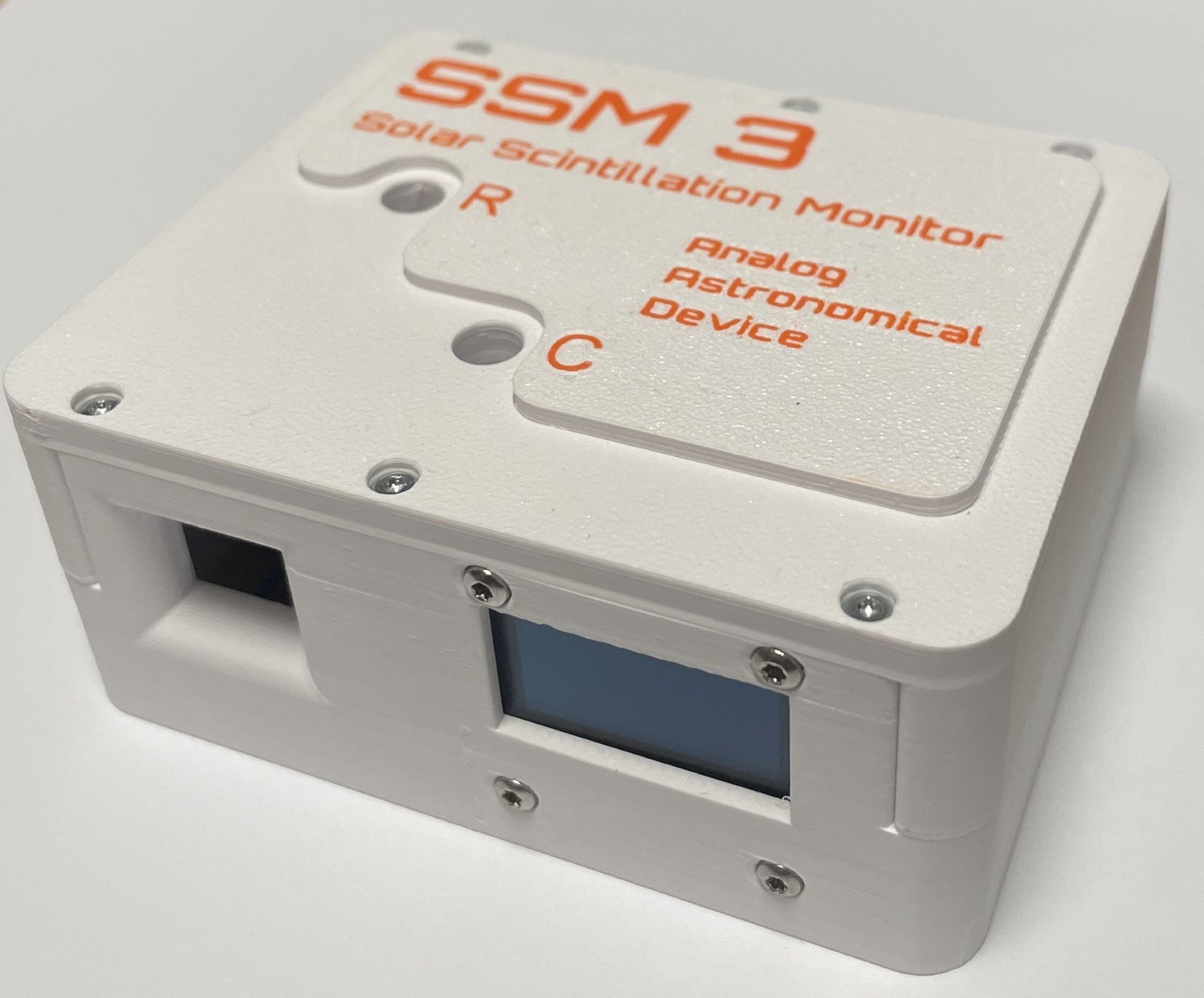
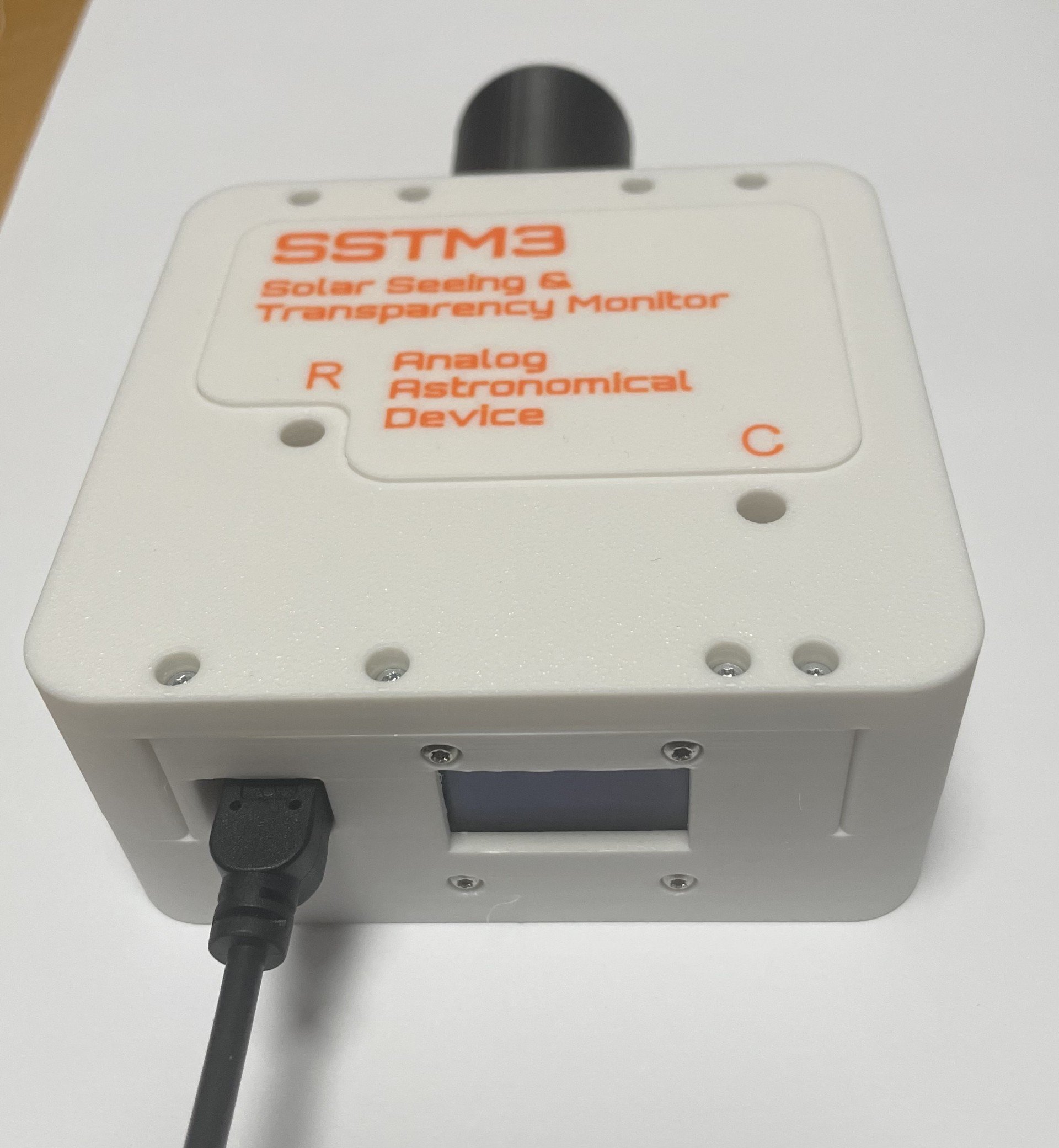
The SSTM3 is a serially connected instrument designed for live solar observing that measures not only seeing but also atmospheric transparency, making observing conditions objectively trackable over an entire session. While seeing describes near-ground turbulence and is reported in arcseconds, the SSTM3 adds additional measurements that reveal changes caused by haze, thin clouds, or varying extinction. This helps the observer decide not only when the image is steady, but also when the atmosphere is truly clear.
Technically, the SSTM3 uses a multi-channel optical measurement chain and records four spectral channels around 525 nm, 635 nm, 870 nm, and 940 nm, along with a reference voltage (vRef). These voltages make it possible to evaluate transparency in a stable and reproducible way and to observe wavelength-dependent attenuation effects. All measurements are continuously transmitted via a serial interface and can be displayed, plotted, logged, and exported using dedicated Windows software.
A key element of the system is the CLEAR calibration. During calibration, the device collects several minutes of data under clear, stable conditions and stores reference values that define the “clear” baseline. All subsequent measurements are evaluated relative to these CLEAR references. Immediately after calibration, the user can assign a TKZ value (1–9), which serves as an anchor so the transparency index is meaningfully scaled and can move up or down during the session (better transparency → TKZ increases, worse transparency → TKZ decreases). Safety mechanisms ensure that critical calibration and model parameters cannot be accidentally altered during normal operation.
In practical use, the SSTM3 complements a pure seeing monitor by adding a second, equally important dimension: How steady is the air? (seeing) and how clear is it? (transparency). With live readouts, rolling plots, 1-Hz logging, and event markers, sessions can be planned and evaluated based on measured data rather than subjective impressions, and results can be compared reliably over time.